Hatchbacks: India’s Everyday Hero This Diwali 2025 | SpotGenie Gyaan
This Diwali 2025, small cars are making big moves. Discover how hatchbacks, now electric, safe, and smarter, still power India’s festive dreams.

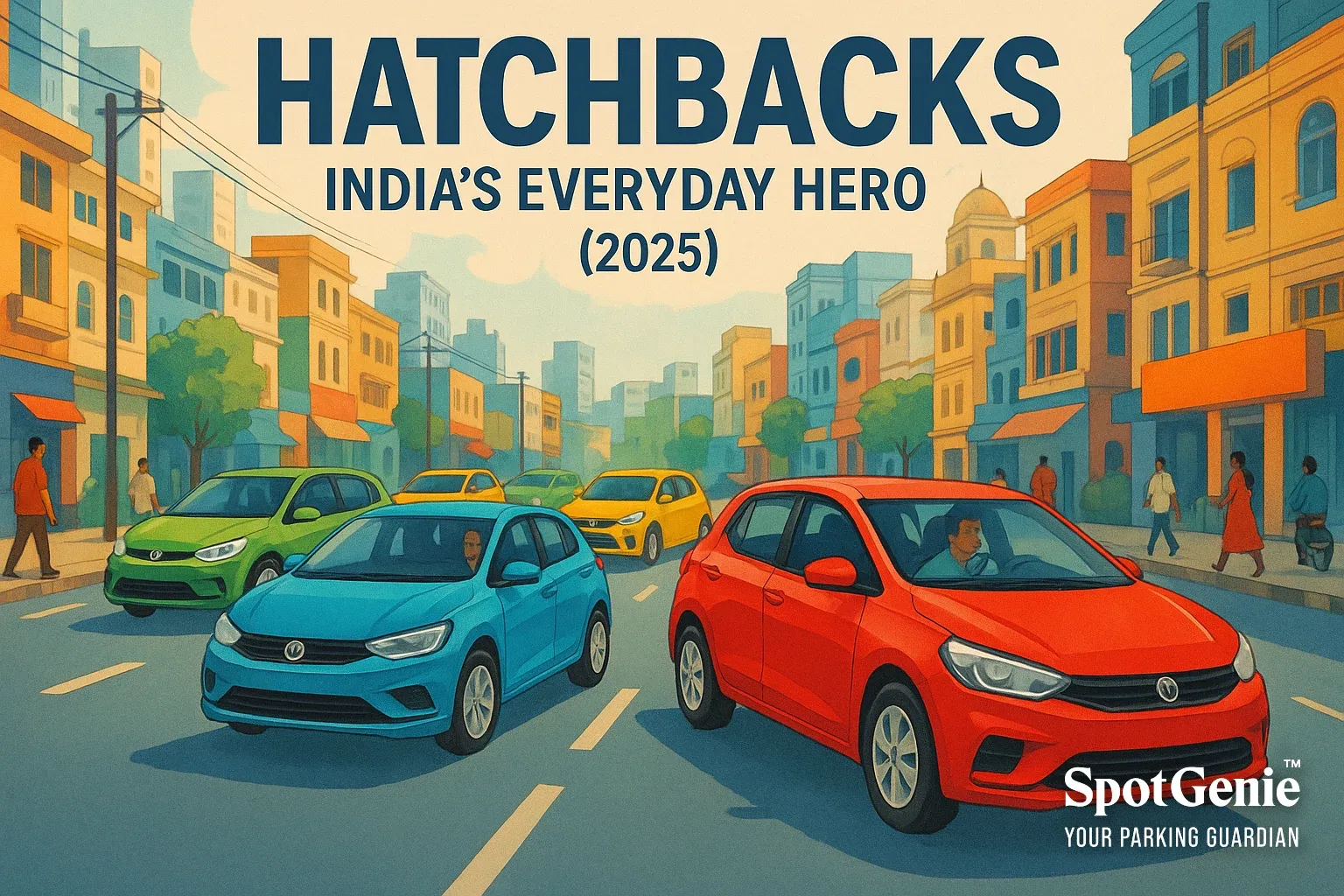
Stop me if you’ve heard this one before.
You bought your first car — and it was a hatchback. Maybe a Maruti 800, Swift, Hyundai Santro, i10, or Tata Tiago. Affordable, easy to park, and built for India’s roads, hatchbacks have quietly carried the dreams of millions.
And even in 2025, despite SUVs dominating billboards, the humble hatchback still rules the streets — now smarter, cleaner, safer, and more connected than ever.
Why Hatchbacks Still Dominate India
According to the Society of Indian Automobile Manufacturers (SIAM), hatchbacks account for over 38% of total passenger car sales in FY2025, only slightly behind compact SUVs. But here’s what keeps them unbeatable:
- Compact form factor: Under 4 metres in length, ideal for Indian parking and traffic conditions.
- Efficient engines: 1.0L–1.2L petrol engines dominate, offering power between 65–90 bhp with impressive mileage (up to 25 km/l in hybrid variants).
- Lightweight construction: Kerb weights typically between 850–1050 kg, contributing to better fuel efficiency and lower emissions.
- Optimised turning radius: Around 4.7–5.0 metres, perfect for narrow city lanes and U-turns.
- Smart value: Affordable service intervals and wide part availability make hatchbacks cost-effective over 7–10 years of ownership.
They remain the top choice for:
- Urban drivers navigating dense city streets.
- First-time car owners entering the auto ecosystem.
- Families needing a reliable second car.
In short: hatchbacks are still India’s mobility backbone — compact, capable, and culturally embedded.
From Petrol to Plug: The 2025 Evolution
Hatchbacks have evolved from simple petrol runabouts to sophisticated hybrids and EVs.
- Tata Tiago EV and MG Comet EV lead India’s small EV revolution, offering real-world ranges of 220–260 km per charge with battery packs between 19–26 kWh.
- Maruti Swift Hybrid 2025 blends a 1.2L petrol with a mild-hybrid motor, achieving over 25 km/l.
- Most new hatchbacks comply with BS6 Phase 2 emission norms and integrate start-stop systems and regenerative braking.
These aren’t just budget cars anymore — they’re gateways to sustainable urban mobility.
Thanks to FAME-II incentives and state EV subsidies, owning an electric hatchback has become financially viable for the middle class — once a segment thought out of reach for EV tech.
Top Hatchbacks Defining 2025
| Model | Key Highlights | Tech / Powertrain | Notable Features |
|---|---|---|---|
| Maruti Swift 2025 (Hybrid) | Refreshed platform, 1.2L DualJet mild-hybrid | 25+ km/l, 90 bhp | 9” touchscreen, 6 airbags, ESP |
| Tata Tiago EV | India’s top-selling small EV | 19.2/24 kWh battery, 250 km range | Fast charging, connected car tech |
| Hyundai Grand i10 Nios | Balanced performance and reliability | 1.2L Kappa petrol | Cruise control, wireless charger |
| MG Comet EV | Compact smart city car | 17.3 kWh battery, 230 km range | i-Smart connectivity, dual screen |
| Citroën eC3 | French electric hatchback with flair | 29.2 kWh battery, 320 km range | Unique styling, fast charging |
Safety and Smart Features: The New Edge
Small no longer means simple.
By 2025, hatchbacks now offer features once exclusive to premium cars:
- Structural integrity: Cars like the Tata Altroz (5-star GNCAP) and Hyundai i10 (3-star) showcase improved crash protection.
- ADAS-ready electronics: Some top trims now support lane assist, collision warnings, and hill-start aids.
- Connected ecosystems: Remote locking, geo-fencing, and vehicle tracking are standard on many models.
- Dual airbags, ABS, EBD, and rear parking sensors are now government-mandated safety inclusions.
- Materials: new-gen high-tensile steel frames, laminated glass, and better NVH insulation boost safety and comfort.
Technical Breakdown: Hatchback Engineering in Simple Terms
| Component | Typical Spec | Why It Matters |
|---|---|---|
| Engine displacement | 998cc–1199cc | Smaller engines reduce tax under India’s <1200cc bracket. |
| Transmission | 5-speed MT / AMT / CVT | Easy driving, better fuel economy. |
| Ground clearance | 165–180 mm | Suitable for Indian road bumps. |
| Boot space | 240–330 L | Perfect balance of utility vs. compactness. |
| Tyre size | 13”–15” | Keeps ride smooth and cost of replacement low. |
The Emotional Connection
There’s something nostalgic about hatchbacks.
They were — and still are — the first car story for most Indian households.
The first road trip, the first dhaba stop, the first late-night drive.
As we enter Diwali 2025, hatchbacks continue to symbolise that new-beginnings energy — practical, proud, and personal. Families still line up at showrooms every October, seeking that perfect small car to bring home with lights, diyas, and new dreams.
The Road Ahead
While SUVs might headline the auto expos, hatchbacks still headline daily life. With EV and hybrid tech merging into this segment, their future is anything but small. In a nation of over a billion journeys, hatchbacks remain the heartbeat of everyday mobility, reliable, relatable, and ready for tomorrow.
Further Reading:
- Know Your Car, A Quick Guide to Every Car Type in India (2025)
- How Legal Self-Drive Businesses Operate
- India’s Crackdown on Illegal Self-Drive Rentals
- Mumbai–Ahmedabad Bullet Train Progress 2025
Follow us on:
🅾 Instagram |
ⓕ Facebook |
𝕏 X |
▶️ YouTube |
🟢 WhatsApp